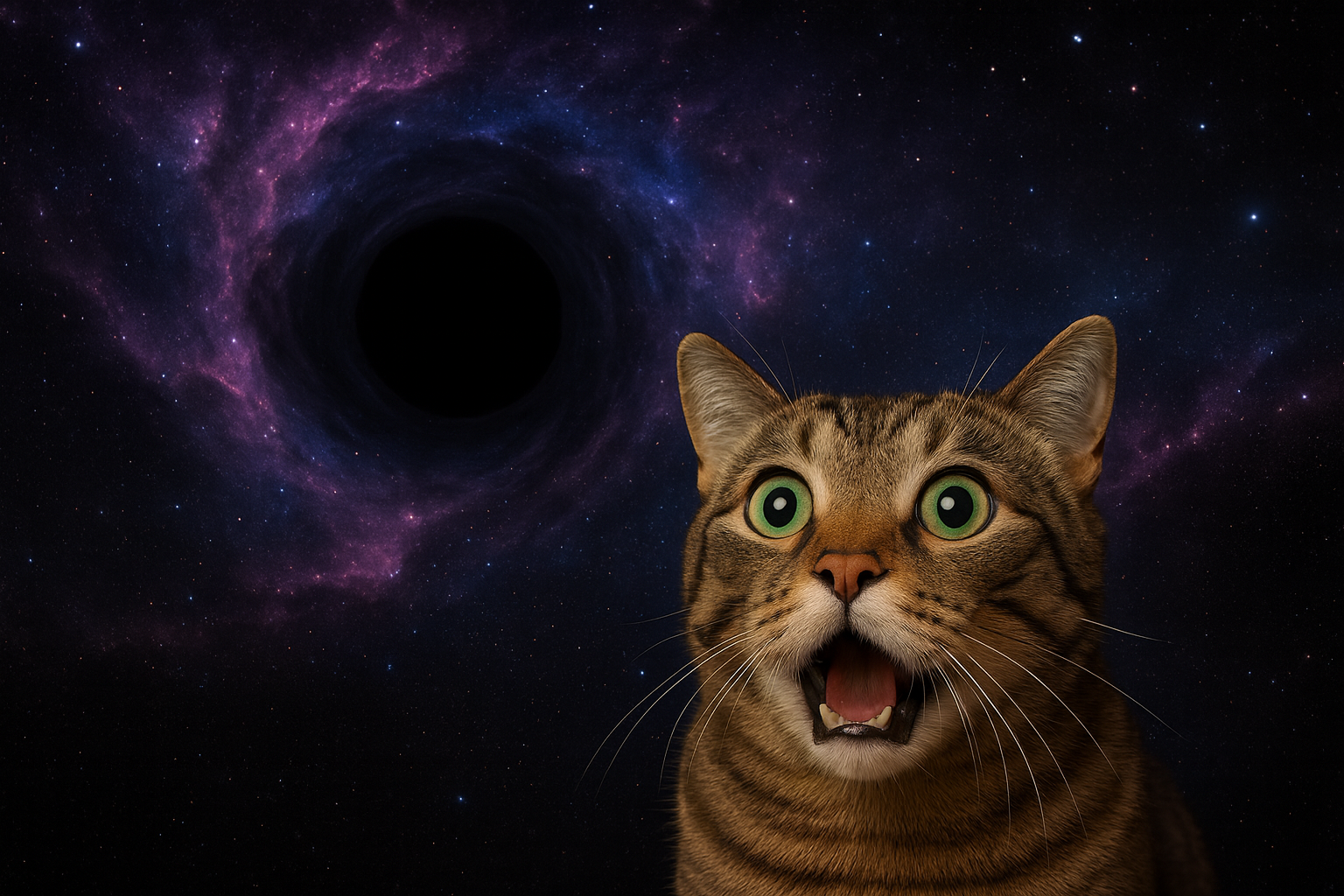
There’s a space between what we know and what we don’t know. That space has a name now: the void.
There’s a space between what we know and what we don’t know. That space has a name now: the void.
Look, I’m not a physicist. I’m not claiming to have discovered some groundbreaking scientific principle that’ll win me a Nobel Prize. But I’ve been thinking about this concept for a while, and I think it deserves a name.
So here it is: Void Theory.
What the Hell Is Void Theory?
Void Theory is basically this: all the biggest questions we’re asking right now – about AI, consciousness, the universe, reality itself – exist in this weird gap between proven science and complete mystery. That gap? That’s the void.
Think about it:
- We don’t really know how consciousness works – Neuroscientists call it the “hard problem of consciousness”, and despite decades of research, we still can’t explain why physical brain activity creates subjective experience
- AI is getting smarter but we can’t explain why it does what it does – Even the companies building these models struggle with what researchers call the “black box problem” – they can see inputs and outputs, but not how the AI actually makes decisions
- Quantum mechanics breaks all the rules and nobody can agree on what it means – The Copenhagen interpretation and many-worlds interpretation are both accepted explanations, and they completely contradict each other
- We’re not sure if we’re living in a simulation or not
- Dark matter makes up most of the universe and we’ve literally never seen it
All of these sit in the void. We have theories, sure. We have models and equations and really smart people making educated guesses. But we don’t have answers.
Why This Matters
Here’s where it gets interesting.
Every major breakthrough in human history happened when someone looked into the void and said “I think I see something.” They couldn’t prove it yet. They just had this feeling that there was something there worth exploring.
Einstein did this with relativity. Darwin did it with evolution. The people working on AI right now are doing it with machine learning.
They’re all working in the void – that uncomfortable space where you’re pretty sure you’re onto something but you can’t quite prove it yet.
The Void in Everyday Life
But here’s the thing: the void isn’t just for scientists and philosophers. We all live in it every day.
You’re in the void when:
- You’re learning something new and it almost makes sense but not quite
- You’re trying to explain a feeling you don’t have words for
- You’re making a decision without having all the information
- You’re creating something that doesn’t exist yet
That confusion? That’s not a bug. That’s the void. And it’s where all the interesting stuff happens.
Why We’re Afraid of the Void
Most people hate uncertainty. We want answers. We want someone to tell us definitively: “This is how it works.”
But the truth is, we’re living in the most uncertain time in human history. Technology is changing faster than we can understand it. Climate is shifting in ways we can’t fully predict. AI might change everything or it might not.
We’re all standing at the edge of the void right now, looking in, trying to figure out what’s coming next.
And that’s terrifying. But it’s also kind of exciting. Fortunately, we can at least control our digital privacy while exploring these uncertain territories. I use Proton VPN for that – not sponsored, just a tool I trust when diving into the unknown corners of the internet.
The Point of Void Theory
So what’s the actual point of giving this a name?
Simple: once you recognize the void exists, you stop being so frustrated by not having all the answers. You realize that nobody has all the answers. We’re all just exploring the same darkness with different flashlights.
Void Theory isn’t about solving mysteries. It’s about being okay with the fact that some mysteries take time to solve – and some might never be solved at all.
It’s about sitting in that uncomfortable space between “I don’t know” and “I’m curious to find out.”
Where We Go From Here
This blog is basically going to be me exploring the void. Looking at all the weird, uncertain, fascinating stuff happening at the edges of technology, science, and human understanding.
Some of it will be grounded in real research. Some of it will be speculation. Most of it will be somewhere in between.
Because that’s what Void Theory is all about: exploring the space where we’re not quite sure what’s real yet – but we’re pretty sure it’s going to be interesting.
So yeah. Welcome to the void. Let’s see what we find.